When Everything Rises: What if the Market’s Euphoria Isn’t About Confidence?
- Sep 15, 2025
- 3 min read
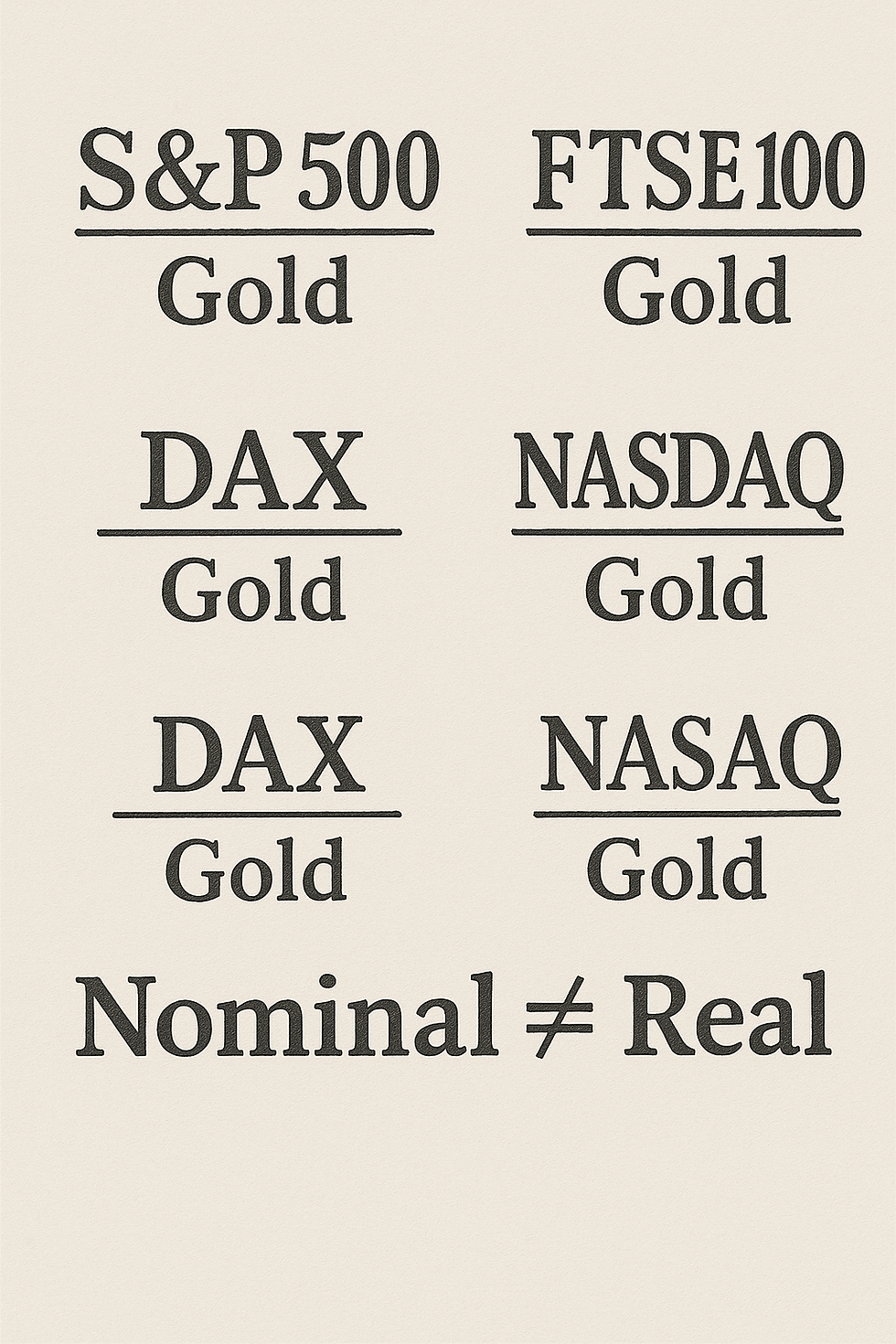
When equities and gold soar in tandem, it raises a question: are investors expressing conviction — or confusion?
Surface Strength, Deeper Signals
On the surface, things look good.The Dow closed above 46,000 for the first time. The S&P 500 and Nasdaq followed suit. Japan’s Nikkei hit all-time highs. Hong Kong’s Hang Seng is climbing, despite China’s economic concerns.
Major corporates are fuelling this rally: Oracle soared after announcing a partnership with OpenAI to produce AI chips. Nvidia’s data centre revenues rose 56% year-on-year. Apple unveiled live-translation AirPods alongside the new iPhone 17. SoftBank jumped. Investors cheered.
But what if this synchronised rise isn’t a sign of stability?
Signs of Fragility
Zoom out, and the backdrop shifts.
Unemployment in the United States has ticked up to 4.3% — the highest since 2021. Non-farm payrolls have slowed to just 22,000 new jobs, the weakest reading in years.
Inflation, thought to be under control, is drifting back upward. Core CPI stands at 2.5%. Producer prices are rising. The Fed’s 2% inflation target looks less achievable than it did just months ago.
Despite this, markets are pricing in not one, but three interest rate cuts by the Federal Reserve before year-end — the first of which is expected this week.
Reflection: The data signals fragility. The markets signal confidence. Which signal is true — or are both false?
Gold Doesn’t Cheer
Gold recently touched an all-time high of $3,675. It currently trades just below that, around $3,637. Even inflation-adjusted, this marks a historic peak. JPMorgan projects a price of $4,000 by mid-2026.
Gold typically rises when investors seek protection — from currency debasement, political risk, policy missteps, or systemic uncertainty. Its current rally suggests more than just hedging. It hints at a deeper discomfort with what lies ahead.
And notably, it climbs even as equities do.
Takeaway: If both risk-on and risk-off assets are rallying, perhaps they are not rallying for different reasons — but for the same one.
The AI Effect, Again
Oracle’s stock leapt after aligning itself with OpenAI. Nvidia remains the market’s bellwether for AI-driven optimism. Apple’s hardware releases were modest, yet share price reactions were positive.
Once again, a single narrative — artificial intelligence — appears to justify steep revaluations across sectors.
There is precedent. In the 1990s, companies added “.com” to their names and watched their valuations explode. Before that, it was “we have an email address”. The pattern is familiar.
This time, the underlying technology may be real. But the pricing-in of future potential feels all too familiar.
The Tightrope of Monetary Policy
This week’s FOMC meeting is being treated as a foregone conclusion: a rate cut. Markets are 93% certain.
Yet inflation remains stubborn. Core CPI is rising, not falling. Producer prices are gaining pace. And unemployment, while not alarming, is climbing steadily.
Overlaying this is political pressure. Former President Trump has renewed criticism of the Fed, calling Chairman Powell incompetent, while simultaneously claiming credit for stock market highs.
Tension: Central banks are being asked to stimulate growth while ignoring the cost of doing so. History suggests this doesn’t end with quiet stability.
Not Advice — But Observation
At Clarus Orbis, we do not offer investment advice. But we do ask different questions.
Why are traditional hedges like gold and risk assets like equities both climbing?Why are markets pricing in easier policy in the face of inflation risks?Why does AI command such unquestioned valuation leverage?
We don’t claim to know the answers. But we believe asking the right questions matters more than ever.
Why We Focus on Predefined Outcomes
When price action masks risk, clarity becomes scarce.When narratives dominate data, conviction becomes fragile.When everyone is celebrating, few are preparing.
Our predefined outcome contracts are not built on forecasts. They’re built on defined triggers, agreed terms, and clear outcomes — no ambiguity, no delay.
Because when uncertainty becomes systemic, structure is a strategy in itself.
This post reflects the views and analysis of Clarus Orbis. It is not investment advice.For more insights, visit clarusorbis.com/blog


Comments