A Bull Market in Metals or a Slow-Motion Currency Collapse?
- r91275
- Oct 6, 2025
- 3 min read
Markets are making new highs while the real economy frays. That tension—weakening fundamentals versus soaring asset prices—isn’t a curiosity; it’s the story. What looks like a clean “precious-metals bull market” is better described as a confidence problem in fiat money.
The economic tape is weakening
The labour market is softening across multiple fronts, not just one noisy print.
Indicator | Direction | Why it matters |
Unemployment rate | Rising for 18+ months | Persistent rises have preceded every recession since 1970. |
Job openings | Down sharply from 2022 peak | Demand for labour is ebbing; hiring appetite is weaker. |
Payroll growth | Faltering and often revised down | Headline strength keeps getting trimmed after the fact. |
Full-time employment | Stagnant | Suggests quality jobs aren’t replacing lost momentum. |
Add a central bank cutting into that weakness and you have the classic conditions for a slowdown that hasn’t yet been officially acknowledged.
So why are markets at records?
Because liquidity and flows can overwhelm fundamentals—for a while.
Falling currency: A weaker dollar pushes global investors toward non-dollar assets—equities, commodities, even real estate.
Deficits and money supply: Large fiscal deficits and a growing money supply are oxygen for asset prices.
Narratives and positioning: AI stories, product cycles and fear of missing out keep risk bids alive even as macro data cools.
The result is a “wall of money” effect. Fundamentals whisper “slowdown”; liquidity shouts “buy”.
Long bonds are blinking
Rate cuts at the short end haven’t translated into lower yields at the long end. Rising long-dated yields signal markets demanding a higher term premium for inflation, issuance and policy risk. In plain English: investors want more compensation to hold paper that can be printed while deficits expand.
This is what currency stress looks like
Gold and silver grind higher and every dip is bought. That is typical when confidence in money—rather than confidence in growth—is the marginal driver.
Gold in foreign currencies (JPY, CHF) making or nearing records points to a broad debasement impulse, not a single-country story.
Japan hints at renewed fiscal-monetary accommodation; gold priced in yen has marched toward a milestone. The lesson isn’t “Japan only”. It’s that policy exhausts the currency first.
This is not a generalised commodities boom. Energy and cyclicals still react to demand. Monetary assets lead when the issue is the unit of account.
The historical rhyme
Episodes from the Weimar Republic to more recent emerging-market crises teach the same lesson: when confidence in the currency erodes, hard assets reprice first. Savers sitting in cash and fixed income take the hit; owners of scarce, non-printable assets preserve optionality.
That doesn’t mean a straight line. It means the path of least resistance favours things that cannot be created by policy decree.
What this means in practice
This is not financial advice; it is a framework for thinking clearly in a warped regime.
Favour tangibles over promises. Precious metals, productive land and selected asset-heavy or cash-rich businesses tend to fare better than fixed claims in debasement cycles.
Be intentional with cash. Keep what you truly need for liquidity. Treat the rest as a melting ice cube.
Mind your jurisdiction and wrapper. Practicalities matter—vaulting, tax treatment, and counterparty risk can dominate headline returns.
Expect volatility. Liquidity can levitate prices even as the economy slows—until it can’t. Positioning should acknowledge both tails: sharp drawdowns and melt-ups.
What to watch from here
Labour internals: participation, full-time vs part-time, and revisions to prior data.
Price dynamics: PCE inflation trends and the breadth of disinflation (or lack thereof).
Forward indicators: PMIs, orders, credit availability.
Term structure: behaviour of 10–30 year yields versus policy rates.
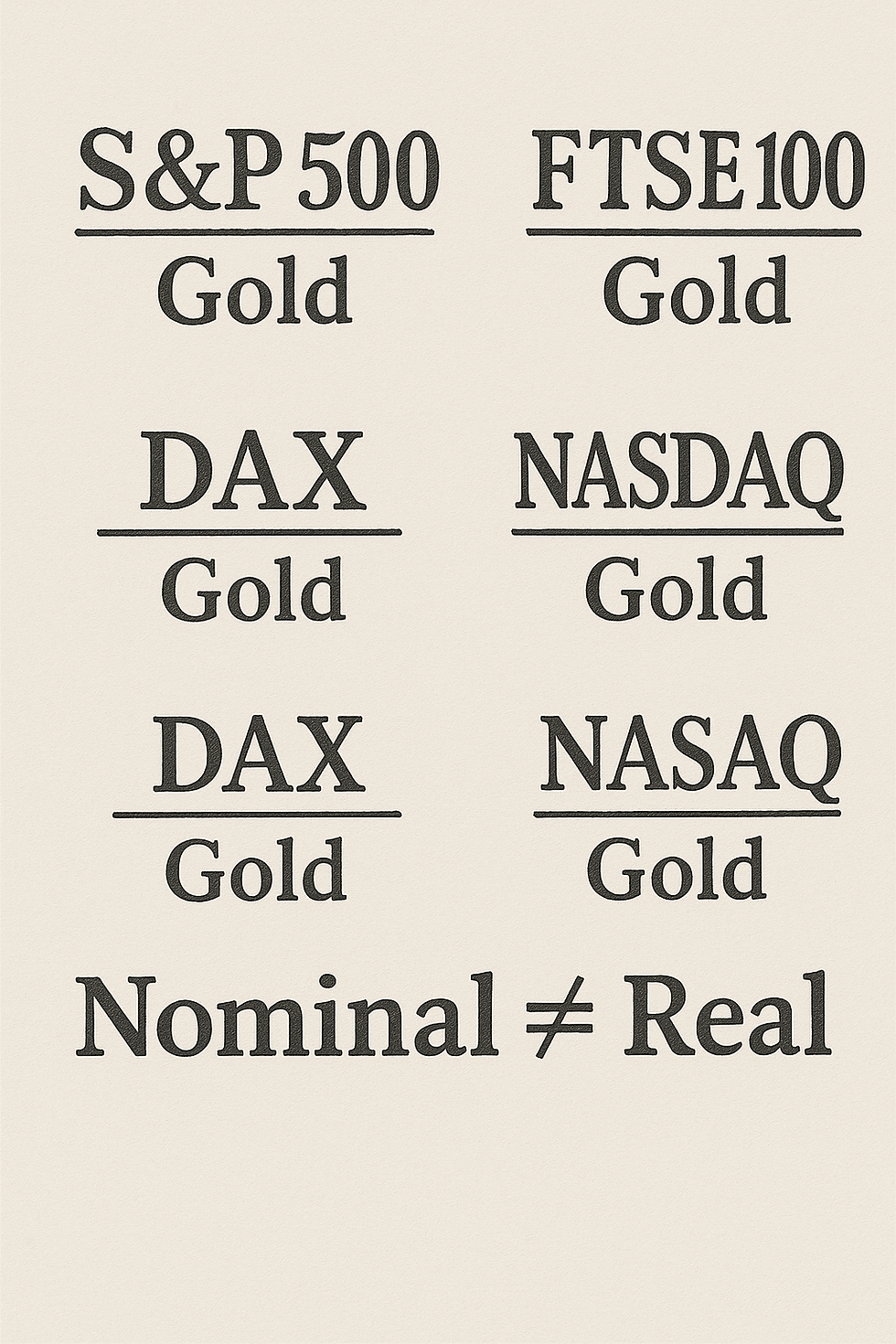
Cross-currency metals: gold priced in JPY/EUR/GBP helps isolate the money signal from the growth signal.
Bottom line
If you looked only at the economy, you would expect a recession. If you looked only at the markets, you would assume a new golden age. Both can be true for a time—but not forever. The simplest explanation for today’s contradiction is that policy and deficits are debasing the currency faster than growth is deteriorating, and markets are repricing anything scarce accordingly.
Call it a bull market in metals if you like. It looks, feels and behaves more like a bear market in money.


Comments