What on Earth Is Going On?
- r91275
- Sep 21, 2025
- 2 min read
This past week gave us a clear reminder of just how strange the global economy has become. On the one hand, the data says growth is slowing, jobs are disappearing, and the US economy may already be in recession. On the other hand, stock markets from New York to Tokyo are breaking records almost daily.
So what’s going on?
The Fed Cuts, the Data Weakens
The Federal Reserve cut rates by 25 basis points — the first move of 2025. Jerome Powell justified it by pointing to a cooling labour market.
The evidence is hard to ignore:
Indicator | Where We Are Now | Why It Matters |
Unemployment | 4.3% (up from 3.3% in 18 months) | Rising unemployment has always preceded recessions |
Job Openings | 7.1m (down from 12.25m in 2022) | Employers are pulling back on hiring |
Non-Farm Payrolls | +22k in Aug | Far below Fed’s 150k monthly goal, likely to be revised down |
Full-Time Employment | Flat | Suggests jobs being created aren’t quality jobs |
Every major recession since 1970 has followed this script: unemployment edges up, payroll growth falters, job offers shrink. By those measures, the recession may already be here — just not officially acknowledged yet.
Yet the Markets Party
Here’s the paradox: while the real economy looks shaky, markets are euphoric.
The Dow Jones, S&P 500, Nasdaq all hit all-time highs this week.
Europe and Japan are also at or near records.
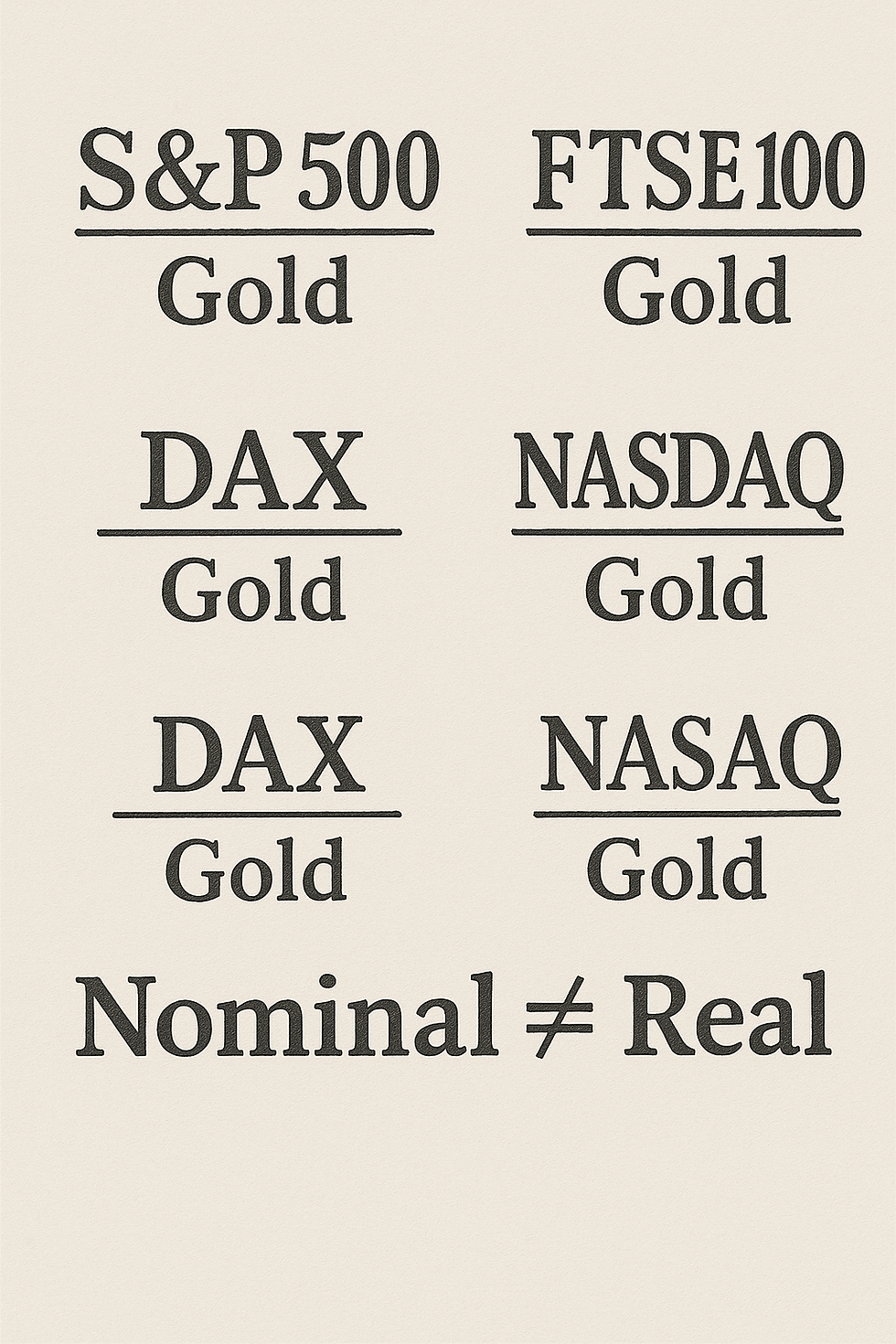
Gold is at a record. Silver is surging. Even meat prices are at records.
Everything, it seems, is up. Why? Three forces:
The dollar is falling — down 11–12% this year, pushing investors into other assets.
Liquidity is plentiful — US money supply is rising.
Government debt is exploding — $2 trillion per year in deficit spending needs to go somewhere, and much of it leaks into financial markets.
This is the “wall of money” effect: fundamentals say slowdown, but liquidity says buy.
The Disconnect
What we’re seeing is a growing disconnect between economic reality and market perception.
Companies like Intel and Novo Nordisk surged, in part, because of AI narratives and efficiency stories — even as they announce job cuts.
Tesla and Apple rallied on product cycles and tax quirks, not on evidence of broad consumer strength.
Investors are rewarding stories and flows of capital, not fundamentals.
It’s a market more driven by fear of missing out than by balance sheets.
What It Means
The hard truth is this:
If you look at the economy alone, you’d expect a recession.
If you look at the markets alone, you’d think we’re in a golden age.
Both can’t be right forever. At some point, either the fundamentals will catch up with markets (through a correction), or liquidity will continue to overwhelm reality (prolonging the rally).
For now, investors face a world where:
Fundamentals warn of weakness.
Liquidity creates bubbles.
Uncertainty is the only certainty.
Closing Thought
When unemployment rises, recessions follow. When deficits expand, markets rise. Right now, both are happening at once.
So the real question isn’t whether we’re in a recession or a bull market. It’s whether today’s rally is the last gasp of easy money — or the new normal of asset-driven growth.
Either way, it’s not “business as usual.” It’s something stranger.


Comments