The Quiet Shift Toward Tangible Value
- Sep 5, 2025
- 5 min read
Gold, Tether, Labour Markets, and the Unfolding Monetary Realignment
Over the last few weeks, subtle signals in financial markets have begun to coalesce into something more meaningful. From gold’s stealth strength to stablecoins quietly accumulating precious metals, from manipulated labour data to murmurings of monetary reconfiguration — the world beneath the surface is beginning to look very different from what headline equity indices suggest.
This piece explores that shift. We’ll unpack market ratios, data credibility, sovereign moves, and emerging investor psychology. As always, this is not financial advice — but it is a map of where the compass appears to be pointing.
Dow/Gold Ratio: History Doesn’t Repeat, But…
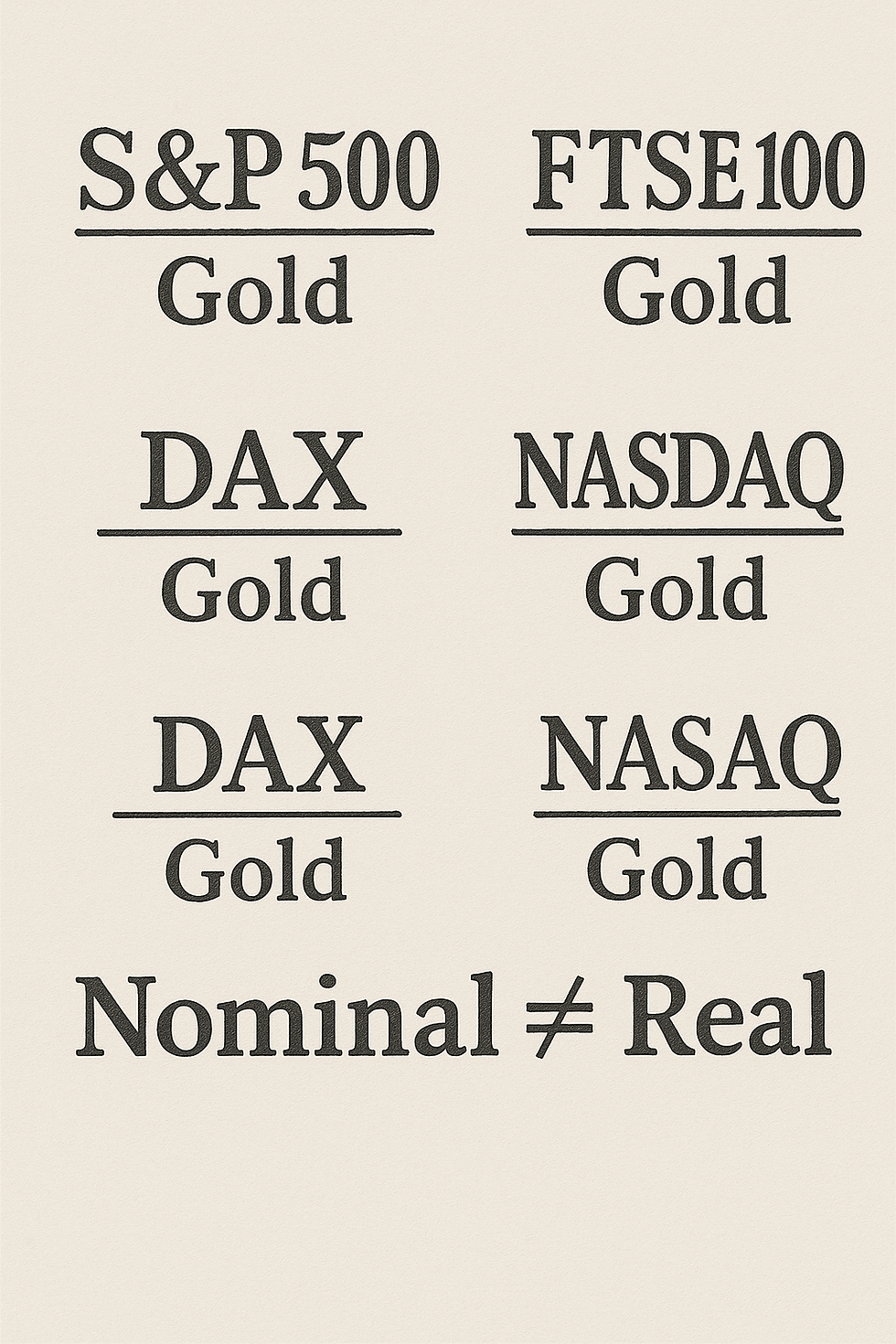
There’s an old market ratio that often escapes mainstream analysis: the Dow/Gold Ratio. It measures how many ounces of gold it takes to buy one unit of the Dow Jones Industrial Average.
What’s notable today is the technical pattern this ratio is showing. A rising wedge has broken down — a structure similar to the one observed in 2007, just before the global financial crisis unfolded. Back then, gold moved from roughly $650 to over $1,000 in seven months, while equity markets began their long descent.
We may or may not see the same kind of crisis, but this divergence — gold strength vs. equity complacency — is worth tracking. At the very least, it suggests a regime shift in market leadership.
Key question: Is gold about to reassert itself as a leading asset in a world of inflated paper values?
Why Gold? The Rebuilding of Trust
What’s driving this renewed interest in gold isn't just historical patterns — it’s a loss of confidence in fiat certainty. There was a time when holding US dollars felt like holding stability. But as geopolitical tensions rise, central bank credibility falters, and fiscal excess becomes the norm, a growing number of investors are asking: What can I own that doesn’t rely on anyone else’s promise?
Gold answers that question simply: It just is. It requires no yield, no board of directors, no bailout. And now, it’s not just central banks quietly stacking — private sector actors are moving too.
Tether, Stablecoins, and Quiet Gold Accumulation
Tether, the largest stablecoin issuer, has reportedly amassed $8.7 billion in gold bars in a Zurich vault, using them as part of the collateral backing its tokens. This may not sound surprising — until you consider how crypto-native firms once dismissed gold as obsolete.
Now, one of the sector’s biggest players is referring to gold as “natural Bitcoin.”
Even more intriguing are reports that Tether is in talks to invest in gold mining operations, possibly as a way to increase exposure while avoiding direct scrutiny. It’s a clever strategy: gain leveraged exposure to a rising gold price via productive assets, while retaining the option of liquidity and control.
Takeaway: Gold isn’t just for sovereigns and boomers anymore — it’s becoming digital money’s hard reserve.
On Data Credibility: Labour Statistics and Market Trust
There’s a deeper issue that ties into all of this: loss of trust in official data.
The US non-farm payroll (NFP) figures are increasingly under scrutiny. Analysts note consistent downward revisions of previous months’ jobs numbers, while headline prints are inflated — possibly to shape short-term narratives.
In the first half of this year alone, over 460,000 jobs have been revised away. In 2024, that figure was 800,000. Private surveys like ADP show job growth far below government estimates. And yet, traders and policymakers continue to anchor to these statistics.
If investors can’t trust labour data — one of the pillars of macro analysis — what else are they second-guessing?
Big question: What happens to markets when confidence in the data infrastructure erodes?
The Fed, Liquidity, and the Market's Real Focus
With economic indicators softening, the Federal Reserve faces a dilemma: hold rates to preserve credibility, or cut them to cushion weakness.
Markets are now pricing in a near 100% probability of a rate cut at the next FOMC meeting in mid-September. Some even speculate about a “jumbo” cut — 50bps or more — if data prints weak enough.
Whether or not the Fed obliges, the market’s obsession with liquidity reveals something more important: price levels don’t matter as much as the direction of policy. In a highly financialised system, flows dominate fundamentals.
And yet, in that environment, the case for tangible value — things you can’t print — gets stronger.
The Broader Geopolitical Landscape: A Multipolar Shift
Beyond data and markets, the geopolitical realignment continues. China, Russia, and members of the Global South are advancing their own agendas outside the dollar system. Even nations like El Salvador are diversifying into both Bitcoin and gold, creating dual-reserve models that blend traditional and digital stores of value.
We’re witnessing a de-dollarisation of psychology, even if the structural changes take longer to manifest. As faith in fiat wanes, demand for independent value stores rises — whether it’s gold coins, sovereign mining operations, or tokenised reserves.
A Changing Investor Psychology
There’s also a subtle but powerful change underway among investors. For years, equity exposure — especially concentrated in US tech — was the default allocation. Passive flows drove valuations sky-high. Today, many are starting to look elsewhere — not necessarily because they’re bearish on tech, but because they’re unsure whether the system itself is stable.
The recent resurgence of interest in gold miners, many of which remain deeply undervalued, suggests that investors are beginning to hedge belief — not just portfolios.
Takeaway: The appetite isn’t for risk, but for resilience.
Final Thoughts: The Case for Tangible Exposure
This isn’t about predicting a crash, nor is it about declaring gold the only answer.
But when large players like Tether, countries like El Salvador, and investors around the world begin reallocating away from fiat instruments, it’s worth paying attention. When market ratios echo previous crisis periods, we should at least ask questions.
We may be heading into a world where value is once again defined not by leverage, narratives, or central bank promises — but by what endures without them.
Questions Worth Asking
If a multi-reserve world is coming, what role will gold play in it?
Can labour and inflation data still be trusted — or is it becoming noise?
How can individual investors protect against not just price volatility, but policy volatility?
Is the move into gold and miners early... or already late?
Final Note
This post is not investment advice. It is a reflection on observable shifts — in data, psychology, and global market architecture. The purpose is not to tell readers what to buy, but to suggest what to consider in a world that’s beginning to question many of its prior assumptions.


Comments