Holding vs. Building: What Capital Really Expresses
- May 5, 2025
- 3 min read
Two Strategies. One Word.
We use the word value to describe many things — from gold and cash to equities and venture capital.
But value doesn’t mean the same thing in every case.
Some assets are meant to hold. Others are meant to build.
Both involve capital. But they carry different logics, different risks, and different signals.
This isn’t about which is better. It’s about what each one says — and what each one needs to work.
What kind of value are we actually talking about — and what are we preparing for?
Holding: The Strategy of Preservation
A store-of-value asset doesn’t aim to grow. It aims to endure.
Gold. Cash. Land. Even some cryptocurrencies.
They offer little in the way of yield, but a great deal in the way of psychological safety.
Their value comes not from what they produce, but what they protect:
– Purchasing power
– Optionality
– Exit from a volatile system
Holding becomes attractive when:
Systems feel stretched
Growth looks unreliable
Trust in coordination breaks down
It’s often a rational response to incoherence — when the future stops making sense, capital pauses.
It’s not a play for return — it’s a plan for resilience.
Building: The Strategy of Participation
Investment is about exposure.
It puts capital in motion — into people, companies, technologies, infrastructure. It accepts risk in the pursuit of return — not just financially, but functionally.
Investments don’t sit still. They bet on:
Systems evolving
Institutions holding
People delivering
They fund what doesn’t yet exist — assuming something new is worth making.
Building isn’t just about growth — it’s a vote for continuity, with adaptation.
What Each One Signals
Neither strategy is neutral.
Holding implies scepticism.
Building implies engagement.
Capital is expressive. It doesn’t just reflect opportunity — it reflects mood.
And today, many portfolios carry a kind of philosophical split:
→ A desire to participate in upside
→ A deep unease about what that upside rests on
The Emotional Paradox in Today’s Markets
We’re seeing two seemingly incompatible signals at once.
Gold has surged to $3,500 last month— an all-time high.
AI stocks continue to lead major indices.
Cash allocations remain elevated.
Capital is chasing possibility — while hedging against the world it depends on.
It’s not confusion. It’s ambivalence.
This paradox isn’t irrational. It’s psychological. It reflects what happens when belief in progress persists — but trust in the platform beneath it weakens.
Reading the Signals: What Price Movements Are Really Telling Us
Markets don’t just reflect fundamentals — they reflect narratives.
And different assets absorb different kinds of belief.
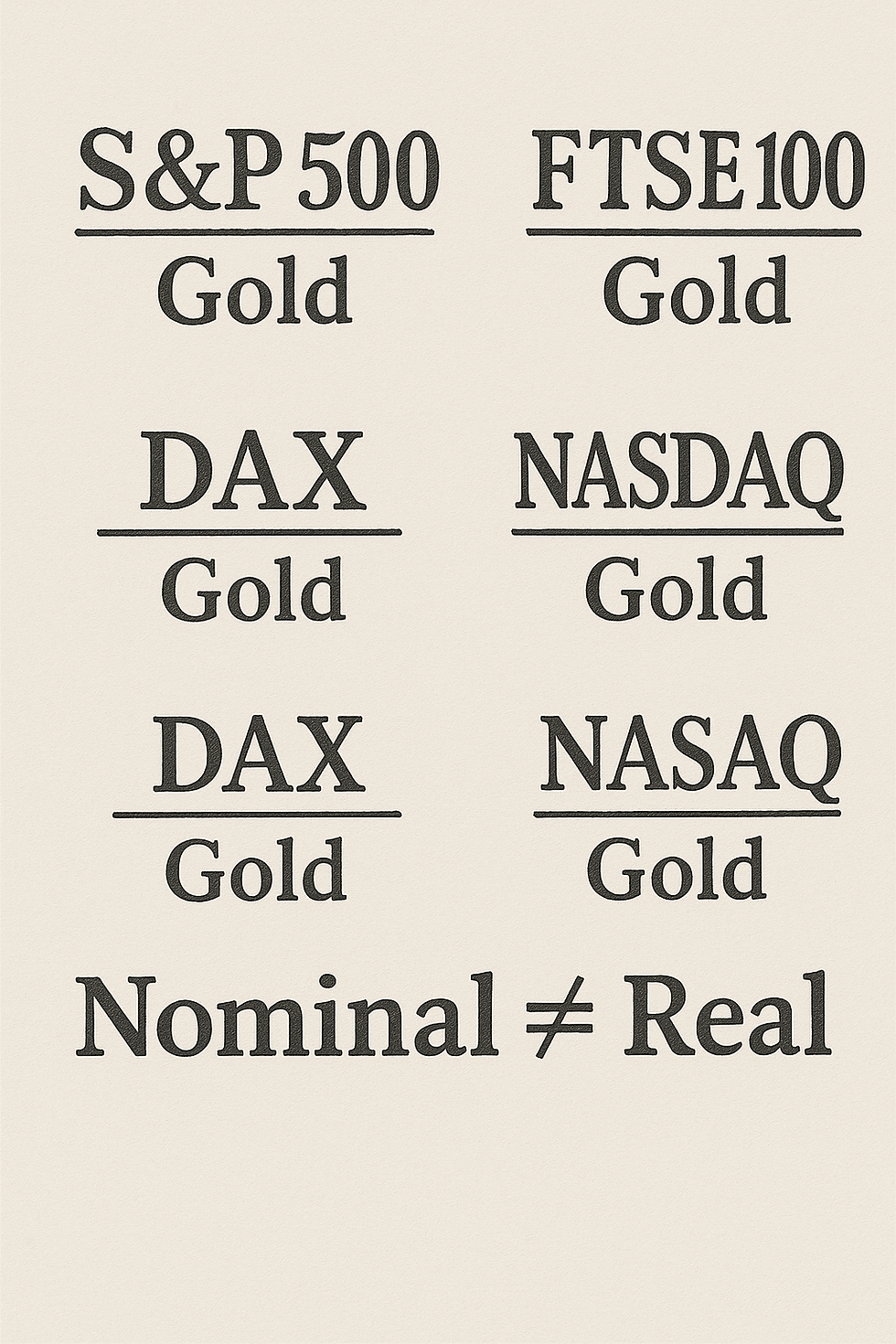
Historically, gold and equities are inversely correlated — not perfectly, but meaningfully.
When confidence in earnings and institutions is high, equities lead.
When confidence breaks — in currencies, policy, or stability — gold becomes dominant.
Gold doesn’t promise yield. It promises escape — from credit risk, political noise, or institutional fatigue. But in 2024 and 2025, both gold and equities are rising together. That doesn’t suggest stability. It suggests capital is hedging the very system it’s investing in.
We’re not just investing in the future.We’re bracing for the possibility it arrives in fragments.
What We’re Really Allocating Toward
Every capital allocation carries a worldview:
Holding | Building | |
Timeframe | Flexible, open-ended | Medium- to long-term |
Risk | Avoidance of loss | Acceptance of volatility |
Return | Preservation of value | Creation of value |
Signal | Doubt in systems | Trust in evolution |
Role | Hedge, insulation, pause | Participation, adaptation, growth |
This isn’t a binary choice. But knowing where you lean — and why — is essential.
What we reward, protect, and fund reveals the kind of future we think is plausible — and what isn’t.
What Kind of Future Are We Expressing?
This isn’t about judgment. It’s about reflection. Holding and building are both rational strategies. But they imply different relationships to the future.
One steps back.
One leans in.
One preserves.
One transforms.
If capital is a signal — and capital is split — what does that say about the world it’s trying to navigate?


Comments