All Sinking Together: Gold, Fiat, and the Shrinking Value of Money
- Sep 8, 2025
- 3 min read
If everything is priced in fiat, and fiat is the problem, then what are you actually measuring?
The Warning That Wasn’t Heeded
Almost two decades ago, a quiet voice in finance was warning of a slow-motion collapse that most ignored: fiat currencies were all sinking—not just the dollar.
That voice was right.
Fast forward to today, and the numbers don’t lie: gold and silver are surging, fiat is shrinking, and yet many still treat this system as if it's sustainable. We’re not here to say “we told you so”—we’re here to help investors understand what’s happening and how to think ahead.
The Price of Trust: Gold’s Silent Message
Gold doesn’t shout. It doesn't default. It just quietly revalues everything else around it. In the past 18 months, gold has climbed more than 50%—from under $2,000 to over $3,600 an ounce. Silver has followed closely.
Those who understood what fiat currency really is—a claim on nothing—have been using real money to protect their purchasing power.
Key Question: If the asset you measure everything with is losing value, do you still know what anything is worth?
They’re All Sinking
People love to debate whether the dollar will crash. But rarely do they zoom out far enough to realise: all fiat currencies are derivatives of the dollar—and when the dollar debases, everything tied to it sinks too.
To understand why, we need to revisit Bretton Woods (1944). That system made the US dollar convertible into gold, and every other major currency tied itself to the dollar. In effect, gold was the foundation of the global monetary order.
When Nixon severed the dollar’s link to gold in 1971, we didn’t just end a system—we entered an experiment: floating exchange rates and unanchored currencies.
Takeaway: Without gold, we have no objective unit of measure for value—only floating abstractions.
Fiat: A System Built on Confidence (and Not Much Else)
Governments want spending without constraints. Gold was a constraint. That’s why it had to go.
But removing gold didn't remove the consequences. We now live in a system where money can be printed without limit, and where central banks are forced to keep rates artificially low—because the debts are simply too large to afford otherwise.
Sound familiar?
From Japan’s political instability to the US’s record deficits, central banks are trapped in a cycle: print, spend, inflate, repeat.
Big Question: If policymakers have no choice but to inflate, where does your store of value come from?
What’s Actually Going On?
Gold is not “going up.” Fiat is going down. What you're seeing is monetary gravity at work.
In 2001, gold was around $254.
By 2006, it had reached $618.
Today, we’re over $3,600.
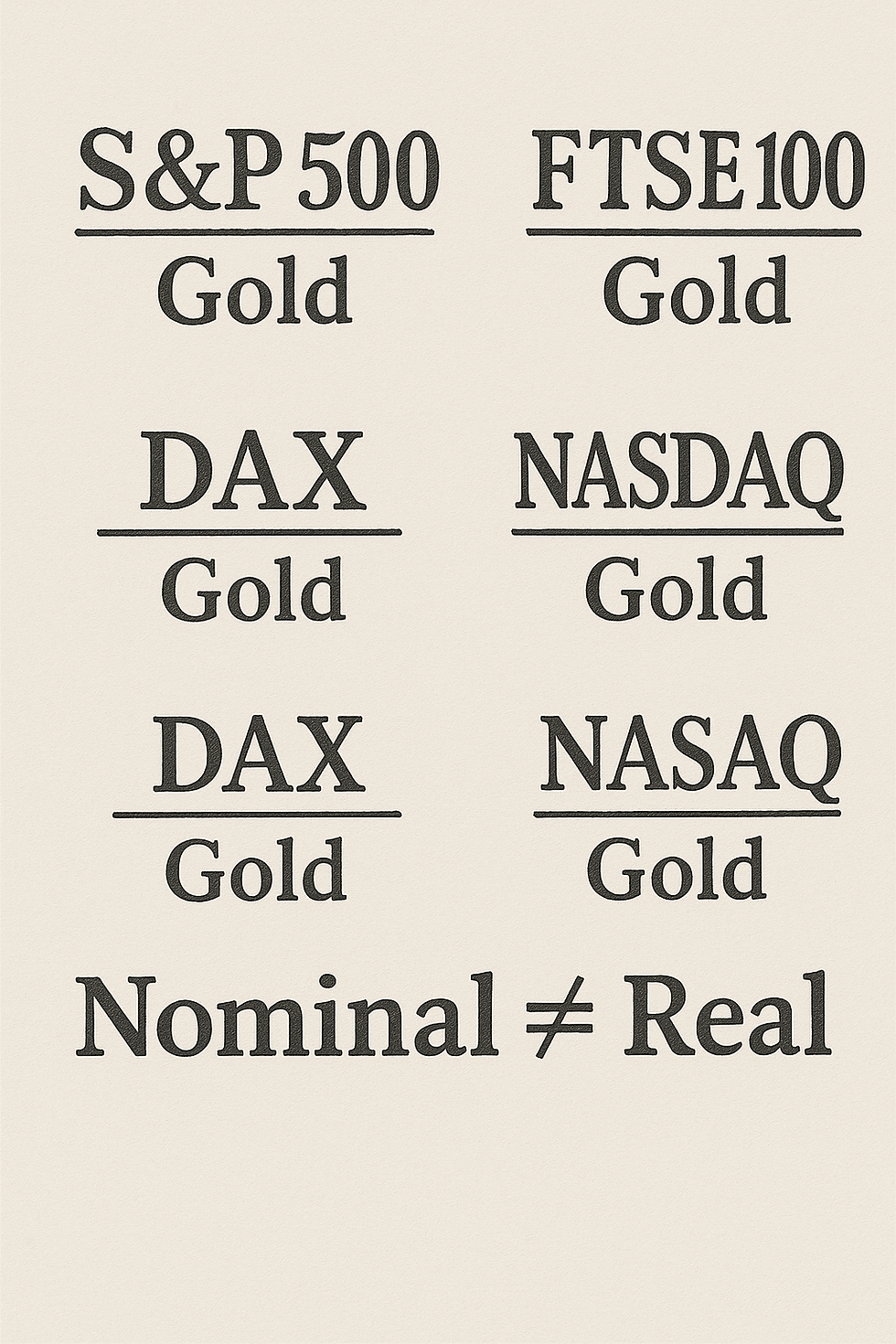
If you're pricing gold in dollars, you're missing the point. It’s the dollar that’s falling, not the metal rising.
And this is not just a US issue. The yen, euro, Swiss franc, and pound have all weakened significantly versus gold. The entire fiat system is slowly deflating in real terms.
Why This Matters for Investors
This isn’t about buying gold or chasing performance. It’s about recognising how distorted the playing field has become.
We live in a world where:
Promises of future payment (fiat) are being inflated away.
Debt levels are so high that interest rates must stay below inflation.
Market pricing is distorted by intervention, not discovery.
Against this backdrop, investors need to think more in terms of resilience than return.
That might mean holding real assets. It might mean diversifying across jurisdictions. It might mean keeping a portion of your wealth outside the financial system entirely. The point is not the product—it’s the principle.
Big Question: If trust is the true currency of the system, how do you hedge against its decline?
Be Ready, Not Predictive
You don’t need to predict collapse to prepare for disruption. You don’t need to be a gold bug to understand that nothing functions without confidence—and confidence, once lost, is hard to regain.
We’re not in the business of predicting when. But we are watching the signs that suggest this is not sustainable. And we believe it's worth building a portfolio, and a mindset, that doesn't depend entirely on the smooth functioning of a fragile system.
Final Thought: Hedging isn’t pessimism—it’s prudence. The world has changed, and portfolios must evolve with it.


Comments